New survey data reveals how and why Americans are increasingly retreating to private spaces to cope with stress, overstimulation, and daily pressure.
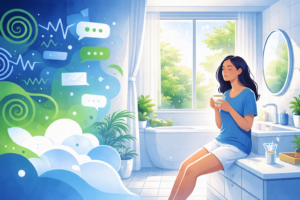
Americans are more connected than ever, but that constant access comes at a cost: the APA found that 77% of Americans experience enough stress to affect their physical health. With nonstop notifications, noisy environments, and blurred lines between work and home, many are reaching a breaking point. The only way that many Americans know how to recover is by being alone.
To better understand what drives people into solitude, Freeman Recovery Center surveyed 1,000 U.S. adults about their habits, triggers, and coping behaviors. The results show just how common it is to take time alone and how that behavior is affecting daily life, work, and relationships.
Key Takeaways
- 91% of Americans said they have retreated to a private space to decompress in the past year, including 47% who said they do so regularly and 34% who do so occasionally.
- 47% retreat to a private space at least once per day, including 22% who do so multiple times daily, while 63% do so three or more times per week.
- 54% said their need for private decompression increased in the past year, including 24% who said it increased significantly.
- 44% said overstimulation from noise or constant conversation triggers their need to step away, while 32% said realizing they had no uninterrupted personal time that day prompts them to decompress.
- 62% retreat to the bedroom to decompress, while 43% say they head to the bathroom and 35% specifically turn to the shower as a private escape.
- 50% said they have used a health-related excuse that was not entirely accurate to step away during the workday, revealing how often decompression is hidden in professional environments.
- 54% scroll social media while decompressing, and 46% sit quietly in silence, while 15% use nicotine, 11% use cannabis, and 8% drink alcohol during these moments.
- 41% said they retreat to be alone when overwhelmed, while 27% said they need daily space from a partner, and 22% said decompression has created emotional distance in a relationship.
A Nearly Universal Behavior
Humans need time to decompress. A study from the University of Reading showed that having enough time to relax and recover from everyday life lowers stress levels and boosts overall well-being. However, everyone has different privacy needs. While some need a few hours in a dark room before they can socialize, others need little to no time alone at all.
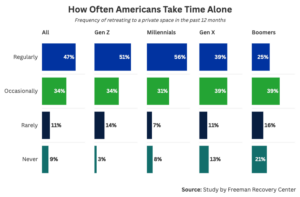
Almost everyone needs privacy at least sometimes: 91% of respondents said they’d sought private spaces to decompress within the past year. Of that majority, 47% have a regular habit of retreating, and 34% do so occasionally. Eleven percent rarely seek out private time, while 9% have not done so at all. Baby boomers and Gen X were the most likely to skip alone time: 21% of Boomers and 13% of Gen X said they hadn’t intentionally gone to a private space even once in the past year. Only 3% of Gen Z said the same, making boomers seven times more likely to forgo their privacy.
For many Americans, privacy is a daily need. Most people (63%) retreat to their spaces three or more times a week, with 25% retreating once a day and 22% doing so multiple times a day. A smaller share (15%) only hides away from the world once or twice a week, and 12% said they do so less than once a week. Gen Z needed the most time to themselves: 27% of Zoomers said they retreat to private spaces multiple times a day, the most of any generation. By contrast, 29% of baby boomers said they rarely seek out private spaces. With nearly a third of Gen Z still living with their parents, many may be carving out space from their boomer parents with much lower privacy needs.
Overstimulated and Overextended
So what exactly is making Americans retreat to their happy places? For many, it’s simple sensory overload; for others, it’s the pressure of unread notifications and always being ready to answer a phone call. From the workplace to the living room, stressors are driving people to spend more time alone.
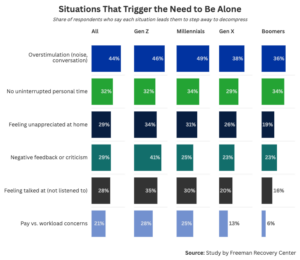
Most people isolated themselves to get a little peace and quiet. Nearly half (44%) cited overstimulation from constant noise as the main reason they retreat to private spaces. This was more common among women than men, with 47% of women and 36% of men citing overstimulation. This may be partly due to the share of women caring for children after a long day at a noisy workplace.
Across all respondents, about a third (32%) said they seek alone time when they realize they’ve gone the whole day without any uninterrupted personal time. Another 29% said they retreat when faced with negative feedback, and a similar share (28%) seek solitude when they feel talked “at” rather than spoken to at work. One in five (21%) need time to themselves when they think about their pay relative to their workload, reflecting a significant portion of workers who are not compensated fairly for their time.
These stressors follow many Americans home: 29% said they go to a private space when they feel unappreciated at home, and 13% said their parenting responsibilities cause them to need more time alone. Another 17% retreat to private spaces after being contacted about work outside normal hours, suggesting that blurred boundaries between work and home increase the need to decompress.
This kind of constant contact is another significant stressor for Americans: 63% said the pressure to be constantly available contributed to their desire to be alone. Nearly half of these respondents (28%) said that the pressure was a significant factor in their need for solitude. Constant push notifications and work-related emails are taking their toll on Americans’ well-being.
Where Americans Go to Be Alone
When Americans need a moment to decompress, most turn to the private spaces closest to them. The most common places to relax were also some of the most effective: private, cozy spaces that help people feel safe and secure. Here’s where people are grabbing their moments for themselves.
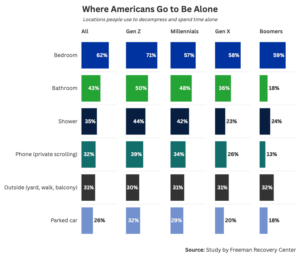
The bedroom is by far the most common retreat, with 62% saying they go there for alone time. Other home spaces also serve as quick escapes: 43% retreat to a bathroom, and 35% use the shower as a place to reset. Women were more likely to tuck themselves into bed: 64% of women said they go to the bedroom to rest, compared to 59% of men.
Not everyone has easy access to personal space at home, though. Overall, only 34% said they have enough personal space at home, while 43% said they somewhat do, leaving a quarter who don’t really have the room they need to be alone.
When Americans lack private space, they improvise. About a third (31%) head outside for a walk or time in the yard, while 26% retreat to a parked car to decompress. A third (32%) said they don’t even need a physical space to decompress in: they scroll through their phones to build a private world wherever they are.
People are grabbing alone time at the office as well, with 11% using a workplace bathroom and 8% slipping away to a breakroom to decompress. In the absence of dedicated private space, Americans create moments of solitude wherever they can.
Escaping Work Without Leaving Work
Many employees step away during the workday when stress or mental fatigue starts to build. For most, taking a few minutes to scroll in the privacy of a workplace bathroom is enough. But others have to go to more extreme measures to get some time to themselves.
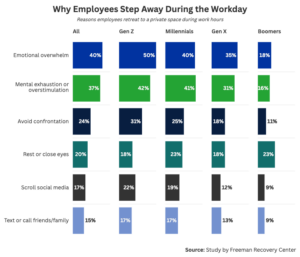
Four in ten workers (40%) said they’ve retreated during the workday because they felt emotionally overwhelmed, while 37% said they did so because they felt mentally drained or overstimulated. Others stepped away to manage specific situations, such as avoiding a confrontation or difficult conversation (24%) or simply resting for a moment and closing their eyes (20%). These findings suggest that short, private breaks are helping employees regulate stress throughout the workday.
However, their bosses may not feel the same way. As a result, it’s become a common response for the study participants to lie to their employers about their reasoning to step away from work. Half of the respondents (51%) said they have used a health-related excuse that wasn’t entirely accurate to step away from work. Of those, 17% said they have done this several times, while 34% said they have done so once or twice. Gen Z fibbed about their time off the most often: 59% of Zoomers have used a health-related excuse to step away from work, compared to 53% of millennials, 45% of Gen X, and only 27% of baby boomers. Younger generations could be more willing to take breaks by any means necessary, or they may know that health-related excuses are the only way they’ll get time off work.
The need to decompress during work hours is also connected to pressures outside the office, with 17% saying being contacted about work off the clock contributes to their need to retreat. These patterns highlight how employees often navigate workplace expectations not by sacrificing rest, but by finding ways to do it discreetly.
Healthy Pause or Risky Habit?
What are Americans doing behind closed doors? Most are looking at their phones, but some are finding other, new ways to decompress. However, not every popular coping mechanism is necessarily a healthy one. For better or worse, here’s what people are turning to when they need to relax.
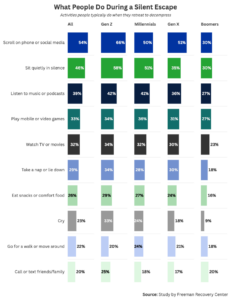
More than half (54%) said they scroll social media during moments of rest, making it the most common way people unwind. Traditional forms of entertainment are still popular, too: 39% listen to music or podcasts, 33% play mobile or video games, and 32% watch TV or movies. A small percentage (8%) talk to an AI chatbot to unwind, rising to 13% among Gen Z. Tech and media are allowing people to mentally escape from their everyday lives, even if their physical privacy is limited.
At the same time, many relaxing behaviors are quieter and more restorative. Nearly half of respondents (46%) said they simply sit in silence when they retreat, while 29% lie down or nap to recover their energy. Another 23% use their private time to cry, allowing themselves the emotional release they need. Crying was most popular among Gen Z, with 33% of Zoomers tearing up behind closed doors.
Over a quarter (26%) reach for snacks or comfort food, reflecting the way that the right food can help boost your mood. A smaller but notable share of respondents report turning to substances, including nicotine or vaping (15%), cannabis (11%), and alcohol (8%). Conversely, 10% said cravings for alcohol or drugs can trigger their desire to retreat in the first place, suggesting that the desire for solitude can sometimes overlap with more complex coping behaviors.
Retreating From Each Other
Even if you love your partner, sometimes you just need a little time to yourself. While every relationship is different, we found that more couples spend intentional time apart than you may think. For some, this is a healthy way to maintain their individuality while in a relationship. For others, it’s a death knell to the whole relationship.
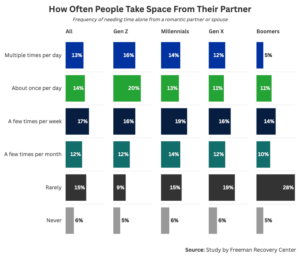
More than a quarter of respondents (27%) said they need space from their partner every day, including 13% who need time alone multiple times per day and 14% who need it about once a day. Another 17% said they step away a few times per week, showing that time apart has become a routine part of many relationships. Two in five (41%) said they retreat to be alone when they feel overwhelmed, showing that many people need solitude to process and recover.
Gen Z needed the most space from their partners, with 36% of the generation needing space from their partners every day. Only 27% of millennials, 22% of Gen X, and 15% of boomers had the same need for solitude. In recent years, Gen Z has become known as the most isolated generation, largely due to social media, but they may be isolating themselves.
That need for space doesn’t always land smoothly with partners. About 22% said their alone time has created emotional distance in a relationship, while 16% said a partner has felt hurt or rejected by their need to step away. Another 15% said it has led to arguments, and the same share (15%) reported ongoing tension. In more serious cases, 7% said their need for alone time contributed to a breakup, rising to 10% among millennials. While alone time itself may not be an indicator of a failed relationship on the horizon, mismatched needs for alone time can indicate fundamental incompatibility and bring the relationship to an end.
Rethinking How We Decompress
Taking time alone has become a normal part of how Americans manage stress, but the frequency and context of that behavior matter. For many, stepping away is a practical way to reset and regain focus in the face of constant noise, workplace demands, and emotional pressure. These small breaks can be productive and even necessary in maintaining overall well-being.
However, when this need for space becomes frequent or reactive, it can lead to unintended consequences. Retreating too often — especially without clear communication — can lead to tension in relationships, misunderstandings at work, and a growing sense of emotional distance from others. In some cases, it may also point to deeper issues like chronic stress or burnout.
The goal isn’t to eliminate alone time, but to approach it more intentionally. Building in regular, healthy ways to decompress, like stepping outside, taking a short break, or unplugging from devices, can reduce the need for more abrupt withdrawal. Being open about the need for space can also help maintain trust and connection, ensuring that time alone supports well-being without coming at the expense of it.
Methodology
This survey was conducted in 2026 and included 1,000 U.S. adults aged 18 and older. Respondents were asked about their behaviors and attitudes related to taking private time to decompress, also referred to as “silent escape” behavior. The sample was stratified by age and gender to reflect U.S. population distributions, and results were segmented accordingly. Percentages may not total 100% due to rounding.
About Freeman Recovery Center
Freeman Recovery Center provides comprehensive addiction treatment and mental health services, helping individuals build healthier coping strategies and long-term recovery plans. By addressing the root causes of stress and substance use, the center supports people in developing sustainable ways to manage emotional and psychological challenges.
Fair Use Statement
This content may be used for non-commercial purposes only; if shared, please provide proper attribution with a link back to Freeman Recovery Center.